



OTTAWA, ON – May 29, 2026 – Crime Writers of Canada (CWC) is pleased to announce the winners for the 2026 Crime Writers of Canada Awards of Excellence in Canadian Crime Writing. Since 1984, Crime Writers of Canada has recognized the best in mystery, crime, suspense fiction, and crime nonfiction by Canadian authors, including citizens abroad and new residents.
As we conclude our review of this year’s outstanding submissions, we are thrilled to celebrate the voices that keep Canadian crime writing at the forefront of the genre. On behalf of the CWC Board and the Awards Committee, we extend our heartfelt congratulations to the talented winners whose work continues to captivate and thrill readers worldwide.
THE 2026 AWARDS OF EXCELLENCE
The Peter Robinson Award for Best Crime Novel
With a $1000 prize
Louise Penny, The Black Wolf, Minotaur Books
Congratulations to Louise Penny and The Black Wolf, our unanimous winner of The Peter Robinson Award for Best Crime Novel for 2026. The jurors were first-time readers of Louise Penny and were inescapably drawn in from the first line to the last. Never has a location held so much depth and complexity as Three Pines. Being the twentieth installment of the Inspector Gamache series, Penny’s masterful knack of weaving a story that carries years of knowledge mixed with a hint of a future and a never overdone richness of character is at its finest. Armand Gamache is simply a brilliant character, and this novel captivates with no good place to put it down. Both series-long and new readers belong here, in this world, that terrifyingly mimics our own. Penny brilliantly threads a complex and interconnected web through police and science agencies, organized crime, government, and even dear friends and foes leaving no one safe…nor innocent. At the heart sits Three Pines, a hopeful refuge from the world-altering revelations Penny crafts to test the very heart and soul of those we love and those we trust most. But, no one will be quite the same after The Black Wolf, Penny insists on it.
Best Crime First Novel
Sponsored by Melodie Campbell with a $1000 prize
Ray Critch, The Beltane Massacre, Breakwater Books
The Beltane Massacre distinguished itself to the jury as an impressive and deeply satisfying debut, one that combines suspense, emotional depth, and a confident command of story from beginning to end. The jurors respected the novel’s ability to deliver a compelling crime narrative while remaining grounded in character, grief, and the lasting consequences of violence. At the same time, it feels fully rooted in contemporary reality, bringing modern pressures of power, surveillance, and instability into a story that never loses its human centre. The narrative unfolds with skill, allowing mystery and momentum to develop alongside a more intimate search for truth. The result is a novel that is both absorbing and affecting, and one that arrives at an ending of real force. As a debut by Newfoundland and Labrador writer Ray Critch, The Beltane Massacre is a remarkable achievement, a worthy winner, and a memorable introduction to a fresh voice in Canadian crime fiction.
Best Crime Novel Set in Canada
Sponsored by Shaftesbury with a $500 prize
C.S. Porter, Salt on Her Tongue, Vagrant Press
Animated by the intense fog and turbulence of the Bay of Fundy, as well as the personal struggles of the varied characters who take the reader on this gripping journey, Salt on Her Tongue keeps the reader engaged through masterful pacing and startling revelations.
The jurors pointed in particular to how well the author evokes the geography, maritime life and weather that forms the setting, and how well it amplifies the conflicts and mysteries in the plot. Also, the characters, from salty locals disdainful of big-city practices to wealthy and powerful elites, are drawn with a clarity that brings them to life, making the reader see their unique perspectives. Notably, the detective’s self-awareness of her mental fragility helps the reader see inside her head, empathizing as she persists despite barriers, including that the people around her seem to be trying to hinder her investigation. Further, the scope of the plot is engaging, convincingly telescoping from local corruption to an unexpected plot twist sure to leave readers satisfied
The Whodunit Award for Best Traditional Mystery
Sponsored by Jane Doe with a $500 prize
Iona Whishaw, The Cost of a Hostage, TouchWood Editions
The jurors were unanimous in awarding this year’s CWC Award of Excellence for Best Traditional Mystery to Iona Whishaw’s The Cost of a Hostage, the twelfth Lane Winslow story.
This book represents all the best elements of Lane’s adventures: engaging characters living in beautifully described settings, both in Canada and this time in Mexico and France, skilfully woven plot strands that come together in a satisfying way at the very end, and Whishaw’s command of the narrative arc examining the rippling effects of Lane’s wartime service on her postwar life.
Although the book takes place in the 1940s, its themes of addiction and drug trafficking are familiar to contemporary readers and yet this is not an anachronism. Whishaw’s characters are of their time. The crimes could be contemporary, but they are solved in a way that is true to the world in which they occur.
Sustaining reader interest over a long series, yet producing books that can also stand alone, is a challenge of the mystery-writing craft, one that Iona Whishaw has met with solid success.
Best Crime Short Story
Sponsored by Crime Writers of Canada with a $200 prize
Sylvia Maultash Warsh, “Polly Wants a Freaking Cracker”, Malice Domestic: Murder Most Humorous, Wildside Press
Everything about this delicious easter-egg-rich criminal confection is as engaging as the title. Author Sylvia Maultash Warsh gets full marks for leading readers through the investigation into a fatal mid-city hit-and-run; narrated from the perspective of one of the most unlikely protagonists to make their Canadian crime lit debut. Jurors were unanimous in their shared delight of the twists, turns and—much to their amazement—legal logical leaps that crime readers everywhere savour. The narrative unfolds with simple straightforward language; the characters are likeable and worth cheering on from start to finish. This story is a delicious blend of suspense, sympathy, action, and well-placed humour. The ending ties up loose ends, but it’s not what the reader is expecting.
Because of its truly unique premise, “Polly Wants A Freaking Cracker” led the pack of this year’s finalists, but the jurors wish to note that all 45 of the entries were riveting reads.
Best French Language Crime Book
Sponsored by Carrick Publishing with a $500 prize
Maureen Martineau, Une nuit d’été à Littlebrook, Héliotrope
Les jurées ont choisi ce roman pour ses nombreuses qualités littéraires, notamment son originalité. Elles ont apprécié le fait que l’histoire évoque un thème très actuel : un monde rural frappé directement par les changements climatiques. Et qu’elle mette en lumière l’impact de cette crise sur les gens qui habitent ces régions.
L’autrice décrit avec beaucoup de doigté les tourments des personnages, notamment le personnage principal. Le rôle des femmes est central dans cette histoire, ce que à quoi le jury a été sensible.
L’écriture de Maureen Martineau est à la fois délicate et percutante. À travers la plume de l’autrice, on découvre un univers riche. Dialogues et narrations s’y côtoient, en un parfait équilibre. Les différentes facettes de l’histoire ; une pénurie d’eau, des cultures menacées par la sécheresse, une étrange maladie génétique, des drames familiaux, des abus sexuels, constituant un aspect important du récit, sont imbriqués de façon fluide et limpide.
Le thème de la vengeance qui mène au crime est présent, en toile de fond, dès les premières pages du roman, ce qui contribue à créer une tension dramatique que les jurées ont particulièrement aimé.
Best Juvenile / YA Crime Book
Sponsored by Superior Shores Press with a $250 prize
Charis Cotter, The Mystery of the Haunted Dance Hall, Tundra Books
The heart of The Mystery of the Haunted Dance Hall is a decades-old love story that ended in tragedy. Charis Cotter pulls in the reader with her gripping storytelling and immersive descriptions of a 1960s bird-watching camp for girls, founded by the elderly Miss Linnet, an austere figure who changes dramatically over the course of the book. The author’s strength lies in her unique characters, both major and minor. Bee, the eccentric, self-deprecating protagonist with no camp experience, meets two girls who become unlikely sidekicks, their friendship growing over time. The writing is gripping as the threesome discover that the older girls in a neighbouring cabin are being lured nightly to a haunted island in the middle of the lake by “fairy music.” The author establishes a connection between the distant past and the present in a powerful tale that engages the reader on an emotional level. A compelling mystery, sparked by a crime, unfolds through an engaging investigative process. Beautifully written, the story blends mystery and the fantastical to create a memorable and poignant novel that stays with the reader.
The Brass Knuckles Award for Best Nonfiction Crime Book
Sponsored by David Reid Simpson Law Firm (Hamilton) with a $300 prize
Julian Sher & Lisa Fitterman, Hitman: The Untold Story of Canada’s Deadliest Assassin, HarperCollins Publishers Ltd
While all the shortlisted titles masterfully explored timely aspects of Canadian crime and justice, Hitman stood out for the jurors from the first page by the quality of the writing, bringing to life characters both major and minor in memorable ways. The jurors appreciated the thorough examination of both the titular character and the law enforcement obstacles that allowed his career to continue unchecked through so many assassinations. The research was deep and broad, uncovering intimate personal moments all the way to necessary development of policing strategies and inter-force communication protocols that continue to inform gang investigations in Canada today.
Best Unpublished Crime Novel manuscript written by an unpublished author
Sponsored by ECW Press with a $500 prize
Anne Burlakoff, Val's Story
By turns introspective and action-packed, Val’s Story is a compelling, layered novel whose prose reads smoothly and whose plot unfurls dramatically. The jurors appreciated this writer’s ability to weave current issues, historicity, personal stakes and the instigating crime into a juicy narrative. The dual perspective structure sustains tension between Eve, the sixty-ish amateur investigator who wants to reveal everyone’s secrets but her own, and Tanya Clarke, the Black homicide detective who wants to crack the case—not to earn a promotion, but to justify the promotion she’s already earned. The jurors noted complex characters, believable and well-developed character motivation, intriguing historical elements, strong dialogue, a gripping opening and controlled interiority as some of the manuscript’s particular strengths. With inclusive representation on race, disability and age, Val’s Story feels modern and satisfying without shying away from some of the ugliest issues of our times.
CWC gratefully acknowledges the generous support of our sponsors
About Crime Writers of Canada
Crime Writers of Canada was founded in 1982 as a professional organization designed to raise the profile of Canadian crime writers. Our members include authors, publishers, editors, booksellers, librarians, reviewers, and literary agents as well as many developing authors. Past winners of the Awards have included such major names in Canadian crime writing as Mario Bolduc, Gail Bowen, Stevie Cameron, Howard Engel, Barbara Fradkin, Louise Penny, Peter Robinson and Eric Wright. We thank our sponsors and volunteers, and the many participating publishers, authors and jurors for their continued support.
For more information about the Awards of Excellence or to enquire about becoming an awards sponsor, contact CWC Awards Manger Ludvica Boota at awards@crimewriterscanada.com.
-end-

Supporting materials for the AGM are now available for download on the CWC website, including the following documents:
To view or download the documents, please use the following link:
Registration
The CWC Annual General Meeting will be held on June 18 at 7:00 p.m. ET via Zoom. Registration closes at 12:00 p.m. ET on June 18. After registration closes, members who have registered will receive the Zoom link by email. All CWC members in good standing may attend the AGM. To register, please use the link below:
In accordance with the CWC bylaws, a Professional Author Member (PAM) in good standing who cannot attend the virtual AGM may appoint another PAM as a proxy to vote on their behalf. If you would like to designate a voting proxy, please use the link below:
CWC 2026 AGM Proxy Voting Form
Volunteering
We are still actively seeking dedicated members to fill open vacancies on our Board of Directors and help lead our organization forward. Nominations are welcome for all Director positions, but we are specifically looking to fill Regional Director positions (open to both PAM and Associate Members) in the following areas:
If you want to contribute to the growth of the Canadian crime writing community, please submit your name using our volunteer form:
AGM Nomination and Volunteering Form
Thank you for your continued support and commitment to keeping our community thriving. We look forward to seeing you online on June 18th!

Francisca Bullock is an aspiring Canadian author with a keen interest in murder and mystery. Though she once strayed into the bubbly waters of Rom-Coms, her long murder-mystery-loving bloodline pulled her back into the shadows of the whodunit world. An accounting graduate and an international finance professional, she lives in Sherbrooke, Quebec, with her three grown sons, three furtive felines, and her most trusted accomplice: her husband.
1. Who is your favourite Canadian author (live or dead, doesn’t have to be mystery)?
It’s difficult to have a favourite! There are so many good ones! Margeret Atwood, Sheri Lapena, Louise Penny, Maureen Jennings, Mordecai Richler, and I really want to start reading Chris Hadfield’s mysteries in space. It’s why I need 32 hours in a day.
2. What is your favourite book?
The books —and I read hundreds so I may have forgotten a few— that I had a hard time putting down were: Louise Penny’s Bury Your Dead; A.J. Finn’s The Woman In The Window; Ruth Ware’s The Death of Mrs. Westaway.
3. What is your favourite movie?
When I want to escape, I watch Pirates Of the Caribbeans, or any of the recent James Bond movies, even the last one!
4. Who was the best James Bond?
Oh, well that is Daniel Craig! Those blue eyes!
5. If you could move to any province (or specific city in Canada) where would you live?
Newfoundland to watch the icebergs go by.
6. What part of the writing process do you enjoy the most?
I see editing as the dessert to an excellent four-course meal.
7. Has a real person ever inspired you to kill them (in your book)?
Oh Yes! And for that reason, I cannot name them 😉
8. On average, how long do you write in a day?
Not long enough. I need 32-hour days to get everything done.
9. Do you have any unfinished manuscripts in your drawer/computer?
No, only unpublished (for now) I usually get things done, even if it takes longer than planned.
10. What is your goal as a writer?
To be published so that my book takes the reader to another place for just a little while!
For over forty years, Crime Writers of Canada (CWC) has flourished as a vibrant, national community. Our strength lies in our membership, whose contributions to crime and mystery fiction are celebrated both here at home and on the international stage.
As we look toward the 2026-2027 term, we are seeking members with fresh perspectives and a passion for our craft to help steer the organization.
How CWC Operates
CWC is governed by a Board of Directors—a total of 12 positions—composed of Professional and Associate members. The Board meets monthly to make pivotal decisions regarding our future direction, finances, and operations.
While our day-to-day activities are managed by a dedicated team of four part-time contractors, our committees are the engines that drive our mission forward. Volunteering—whether as a director or a committee member—is a rewarding way to deepen your connection to the industry and network with fellow crime writers across the country.
Save the Date: Annual General Meeting 2026
Our AGM will be held on Zoom on June 18th, 2026, at 7 PM ET. During this meeting, Professional Author Members (PAMs) will elect the Board of Directors for the upcoming year. Following the AGM, the newly appointed Directors will meet the week of June 22–25 to elect the Board Officers:
AGM Registration & Materials
All relevant documents for the AGM, including reports and the agenda, will be available by the end of May. At that time, we will send out a membership-wide email containing the official registration link and access to all meeting materials.
Call for Nominations: Board of Directors
We are currently seeking nominations for our 12 Board positions. Current Directors may stand for re-election, but nominations are open and welcome for all:
Regional Directors:
Directors at Large:
Committee Volunteers Needed: We also need members for our various committees, including Awards, Jury Selection, Jury Chair, Marketing, Fundraising, Membership, Mentorship and Board Secretary. To learn more about these roles, please use the link below:
Take the Next Step
Thank you for being a part of this community. We look forward to seeing you—and your nominations—this June!

Writing is often a solitary pursuit, but refining your manuscript shouldn’t be. We are thrilled to officially announce the launch of the CWC Club Critique Program, a new member-exclusive initiative designed to help you sharpen your craft, find your rhythm, and get your work submission-ready.
Whether you’re writing cozy mysteries, gritty noir, true crime, or psychological thrillers, our peer-to-peer critique groups provide a safe, professional environment to receive constructive feedback and connect with fellow creators across the country.
How the Program Works
We are Looking for Leads! To make this program a success, we are looking for Group Leads (Facilitators). If you are organized and enjoy moderating discussions, consider stepping up. Leads ensure the meetings stay on track and the "Rules of Engagement" are followed. (Leads are also full participating members of their critique group).
Want to Join? If you have a work-in-progress and are ready to give and receive professional feedback, we want to hear from you.
If you are interested in joining a group or stepping up as a Lead, please email me directly at ed@crimewriterscanada.com.
Please use "Club Critique" as your subject line.
For full program details, including our Rules of Engagement, please visit our new Club Critique page on the CWC website.
In your email, please let me know:
We are excited to see the incredible work that will come out of these groups.
OTTAWA, ON – April 24, 2026 – Crime Writers of Canada (CWC) is pleased to announce the Shortlists for the 2026 Crime Writers of Canada Awards of Excellence in Canadian Crime Writing. Since 1984, Crime Writers of Canada has recognized the best in mystery, crime, suspense fiction, and crime nonfiction by Canadian authors, including citizens abroad and new residents.
On behalf of CWC, the Awards Committee extends congratulations to all the talented finalists. Winners will be announced on Friday, May 29, 2026.
GRAND MASTER AWARD RECIPIENT
Crime Writers of Canada (CWC) is proud to announce that Rick Mofina has been named the recipient of the 2026 Grand Master Award. This prestigious biennial honor recognizes a Canadian crime writer with a substantial body of work who has garnered significant national and international acclaim while demonstrating a steadfast commitment to the crime-writing community. CWC selected Mofina for this distinction based on his prolific output, professional integrity, and years of dedicated service to both the organization and the genre.
With a career spanning over 30 years and more than 30 novels published in nearly 30 countries, Rick Mofina has become one of the most respected voices in the thriller genre. A former journalist for The Toronto Star, The Ottawa Citizen, and The Calgary Herald, Mofina’s fiction is famously infused with "boots-on-the-ground" realism. His reporting from death row, patrols with the RCMP, and dispatches from global conflict zones have lent his work a unique grit and procedural accuracy that earned him the title of "one of the best thriller writers in the business" from Library Journal.
Beyond his commercial and critical success—including two CWC Awards of Excellence and multiple nominations for the ITW Thriller and Shamus Awards—Mofina was chosen for his exceptional service to the CWC. He has been a consistent mentor to emerging authors, a frequent contributor to professional development series, and a tireless advocate for the Canadian crime-writing community.
"Rick Mofina represents the very best of what the Grand Master Award stands for," the Committee noted. "It isn't just about the books sold, but the way he has consistently elevated the genre and supported his peers. His generosity in sharing his expertise has made an indelible mark on our community."
THE 2026 AWARDS OF EXCELLENCE SHORTLISTS
The Peter Robinson Award for Best Crime Novel
With a $1000 prize
Sue Hincenbergs, The Retirement Plan, HarperCollins Publishers Ltd
Jen Sookfong Lee, The Hunger We Pass Down, McClelland & Stewart
Tamara L. Miller, Into the Fall, Thomas and Mercer
Louise Penny, The Black Wolf, Minotaur Books
Eddy Boudel Tan, The Tiger and the Cosmonaut, Viking Canada
Best Crime First Novel
Sponsored by Melodie Campbell with a $1000 prize
Ray Critch, The Beltane Massacre, Breakwater Books
Jan Field, Yesterday’s Lies, La Cloche Publishing
Joel Nedecky, The Broken Detective, Run Amok Crime
David L. Tucker, A Painting to Die For, Otter & Osprey Press
A.L. Wahdel, Too Dark For the Light, Butterfly 80 Publishing
Best Crime Novel Set in Canada
Sponsored by Shaftesbury with a $500 prize
Lis Angus, That Other Family, Next Chapter
Angela Douglas, Every Fall, EOB Publishing
Uzma Jalaluddin, Detective Aunty, HarperCollins Publishers Ltd
C.S. Porter, Salt on Her Tongue, Vagrant Press
Chevy Stevens, The Hitchhikers, St. Martin’s Press
The Whodunit Award for Best Traditional Mystery
Sponsored by Jane Doe with a $500 prize
Shelley Adina, The Engineer’s Nemesis, Moonshell Books
Mel Anastasiou, Stella Ryman and the Search for Thelma Hu, Pulp Literature Press
Alice Fitzpatrick, A Dark Death, Stonehouse Publishing
Laury Silvers, Some Justice: A Ghazi Ammar Medieval Mystery, Independently Published
Iona Whishaw, The Cost of a Hostage, TouchWood Editions
Best Crime Short Story
Sponsored by Crime Writers of Canada with a $200 prize
Lis Angus, Under the Circumstances, A Capital Mystery Anthology, Ottawa Press and Publishing
Madeleine Harris Callway, The Lost Diner, Pulp Literature, Issue 47, Summer 2025
Barbara Fradkin, Cold Shock, A Capital Mystery Anthology, Ottawa Press and Publishing
Billie Livingston, The Headache, Dark Yonder, Issue 11, Nov. 2025
Sylvia Maultash Warsh, Polly Wants a Freaking Cracker, Malice Domestic: Murder Most Humorous, Wildside Press
Best French Language Crime Book
Sponsored by Carrick Publishing with a $500 prize
Chrystine Brouillet, Le regard des autres, Druide
André Jacques, Jeux d’ombres, Druide
Steve Laflamme, La mémoire du labyrinthe, Libre Expression
Maureen Martineau, Une nuit d’été à Littlebrook, Héliotrope
Martin Michaud, Delta Zéro, Libre Expression
Best Juvenile / YA Crime Book
Sponsored by Superior Shores Press with a $250 prize
Charis Cotter The Mystery of the Haunted Dancehall, Tundra Books
Vicki Grant, Death by Whoopee Cushion, Tundra Books
Claire Hatcher-Smith, The Mizzy Mysteries: A Skeleton in the Closet, Tundra Books
Tanya Lloyd Kyi, The City of Lost Cats, Tundra Books
John Lekich, Bark Twice for Murder, Orca Book Publishers
The Brass Knuckles Award for Best Nonfiction Crime Book
Sponsored by David Reid Simpson Law Firm (Hamilton) with a $300 prize
Robert Cree with Therese Greenwood, The Many Names of Robert Cree: How a First Nations Chief, Brought Ancient Wisdom to Big Business and Prosperity to His People, ECW Press
John L. Hill, Acts of Darkness: Notorious Criminals, Their Defenders, Prosecutors, and Jailers, Durvile & UpRoute
Kathleen Lippa, Arctic Predator: The Crimes of Edward Horne Against Children in Canada’s North, Dundurn Press
Lorna Poplak, On the Lam: Great (and Not So Great) Escapes from Prison, Dundurn Press
Julian Sher & Lisa Fitterman, Hitman: The Untold Story of Canada’s Deadliest Assassin, HarperCollins Publishers Ltd
Best Unpublished Crime Novel manuscript written by an unpublished author
Sponsored by ECW Press with a $500 prize
Anne Burlakoff, Val's Story
William Hall, The Less You Know
Francis K. Lalumière, Lens Flare
Barbara Stokes, Death Scent
Isabelle Zimmermann, Blistered
CWC gratefully acknowledges the generous support of our sponsors
About Crime Writers of Canada
Crime Writers of Canada was founded in 1982 as a professional organization designed to raise the profile of Canadian crime writers. Our members include authors, publishers, editors, booksellers, librarians, reviewers, and literary agents as well as many developing authors. Past winners of the Awards have included such major names in Canadian crime writing as Mario Bolduc, Gail Bowen, Stevie Cameron, Howard Engel, Barbara Fradkin, Louise Penny, Peter Robinson and Eric Wright. We thank our sponsors and volunteers, and the many participating publishers, authors and judges for their continued support.
For more information about the Awards of Excellence or to enquire about becoming an awards sponsor, contact CWC Awards Manger Ludvica Boota at awards@crimewriterscanada.com.
-end-

John L. Hill is a retired criminal and prison law lawyer. He taught correctional law at the Queen's and University of Windsor Law Schools. But in private practice, he dealt with some of Canada's most notorious criminals as well as with some of Canada's best prosecutors and defence lawyers. In retirement, he has become a nonfiction writer. He is a columnist for Law 360 Canada (formerly The Lawyer's Daily), an online newspaper for the legal community. He has also published three books: Pine Box Parole: Terry Fitzsimmons and the Quest to End Solitary Confinement, The Rest of the [True Crime] Story, and Acts of Darkness. He has also published a story dealing with slavery in southeastern Ontario in a Florida-based magazine.
1: Who is your favourite Canadian author?
I first read Stephen Leacock's works in high school. His Sunshine Sketches of a Little Town struck a chord with me because I grew up in a village with fewer than 2000 inhabitants. I could certainly relate to the characters and the light-hearted way he dealt with them. I guess Leacock had even more of an effect on me than I realized as a high school student. I read that he was a political scientist. That revelation led me to take an Honours B.A. in political science at Queen’s University and to stay on to earn an M.A., writing my thesis on Municipal government before I entered law school.
2: What is your favourite movie?
My all-time favourite movie is Cool Hand Luke, starring Paul Newman as the title character, a nonconformist prisoner in a minimum-security southern prison. I saw the movie while I was an undergraduate. I suspect it stayed with me and fed my intrigue on how prisoners think and behave when I ended up practicing prison law and returning to Queen’s to teach it. Of course, my writing is based on true stories of prisoners and their involvement with the law.
3: If they were making a movie from one of your books, who would play the protagonist?
They are not making a movie about my books, but I have been contacted by a producer and screenwriter wanting to turn my first book, Pine Box Parole, into a TV series. In my book, I describe how the prison system turned Terry Fitzsimmons from a rebellious youth into a cold-blooded killer because of the torture he endured, spending six years in solitary confinement. It will not be up to me to cast the series if it is picked up, but I have nonetheless mulled casting over in my mind. I would like to see Vancouver actor Shane Meier play the role of Fitzsimmons. I cannot even imagine who would be the character of Fitzsimmons’ lawyer (me!)
4: What inspires you to write?
As a lawyer, I had to write numerous letters and legal documents, including case briefs and court factums. Once I retired, I recalled making a promise to Terry Fitzsimmons, who urged me to tell his story. Once I sat down in my retirement from my law practice, I set out to write the Fitzsimmons tale. I found that I enjoyed writing and that, by engaging readers with the deficiencies I spotted in our legal system, I could also contribute to positive change. Not only have I now written 3 books, but I also write columns for Law360 Canada, an online newspaper for the legal community, commenting on recent cases.
5: What part of the writing process do you enjoy the most? (i.e., first draft, outlining, editing)
I am in great awe of fiction writers who have to dream up believable tales. My stories are non-fiction. The plot has already been played out. My job is to record it in words from a particular perspective. When I write, I think about the best way to approach a story and then bang out a first draft. The real fun is editing that draft to make it a persuasive narrative. I have only one published work of fiction. It is a story I made up about a man wrongly accused of murdering a local landlord. I enjoyed writing it, but I concluded that writing fiction is much more complicated than writing nonfiction.
6: Has a real person ever inspired a character in your stories?
All my characters are real. I have never disclosed any information that would be subject to solicitor-client privilege. All the facts I set out have been reported in the newspapers or contained in court judgments, which are public records. I am always amazed that even the pettiest of petty criminals have interesting stories to tell. If you look at Norman Mailer’s 1100-page book about Gary Gilmore, The Executioner’s Song, you will find that a substantial amount of his narrative deals with description and anecdotes of characters we have never heard of. Yet it is that interplay that led to Gilmore becoming the murderer that we are all familiar with. The characters must be real, but so must those the main characters interact with.
7: Do you have any unfinished manuscripts in your drawer/computer?
I have an 80,000-word manuscript on my hard drive now. It's just too early to turn my attention to seeking a publisher. I’m still in the process of promoting my latest book, Acts of Darkness.
8: Are you part of a writing critique group?
I am part of a small group that meets monthly for 1 hour to chat about writing and encourage each other to keep going. We will sometimes exchange work and seek criticism. The first chapter of my latest book, Acts of Darkness, deals with two men who I believe have been wrongly convicted of massive drug importation, supposedly furthering the work of a Sinaloa cartel and are now serving life imprisonment sentences. Before making final edits, I passed my manuscript to our writing group and asked them the simple question: “After reading this, are you convinced of their innocence?” The feedback was impressive. I was able to revise my work so that both men have hired lawyers seeking exoneration and have been paroled.
9: What is your goal as a writer?
I am hopeful that my work will lead average Canadians to not fall for the rhetoric that we must get tough on crime and that we are all less safe because those granted bail are likely to reoffend. I try to stress that our courts are very good at assessing “what” was done that constituted a crime, but only lately have we started asking the question of “why” these people committed the offences. When we take a hard look at the problem, we see that we have not looked as closely as we should have when children are emotionally or sexually abused. We blame everything on psychiatric problems or drug addiction. Many of those problems could have been corrected early on by providing treatment rather than relying on later punishment. We do live in an unsafe world, but we really do nothing or little when the problem is developing to correct it.
10: Other than writing, what is your passion?
I enjoy a very easy-going home life with my wife and our new Portuguese Water Dog, Caboose (The name is to remind us that we are getting old, and Caboose will be our last dog). We take long walks with the pup daily, but have to get up early because she is so well house-trained. The only other hobby I have is participating from time to time as a background performer (extra) on TV and movie tapings. I have a friend in the Toronto movie industry who has encouraged me to try it out from time to time. I saw myself on the big screen for a millisecond in IT Chapter 2. I was also a performer in Cate Blanchett’s Mrs. America, an FBI agent in The Comey Rule, and, this year, in episodes of Ginny & Georgia. I have no illusion that I will make money. I have a lot of fun doing it.

We are thrilled to announce that Crime Writers of Canada will be sponsoring Bouchercon Calgary 2026! The conference takes place from October 21–25, 2026. As part of our sponsorship, CWC is hosting the official Media Room, featuring three days of programming. We will be running 11 dedicated CWC panels, each with approximately four spots. This is a fantastic opportunity to showcase our members' expertise and connect with the international crime-writing community.
We need your help to fill these spots! Whether you have a fully formed panel idea, a specific area of expertise to share, or simply want to join a discussion with your peers, we want to hear from you.
Important Program Details
CWC Sessions vs. General Programming: Please note that this application is specifically for CWC-sponsored sessions in the Media Room. This is independent of any general Bouchercon programming or panels you may be invited to by the convention organizers.
Expenses: Participation as a panelist is voluntary. Panelists are not paid and are responsible for their own convention registration, travel, and accommodation costs.
Book Room: CWC will also have a table in the Book Room. A separate application for Book Room signings and volunteer slots will be sent out this summer.
How to Participate
To be considered for a Media Room session, please complete our Application Form by May 3, 2026.
On Friday, June 5th to Sunday June 7th, 2026, the Toronto International Festival of Authors is hosting MOTIVE, an annual festival focused on crime and mystery. Taking place at Victoria College, University of Toronto, this three-day weekend festival will celebrate writers from Canada and across the world.
With cozy crime, police procedural, psychological thriller and true crime taking the stage, the Festival will be a weekend of suspense, twists and turns as we uncover the secrets behind some of the world’s most gripping stories. Meet the masters of mystery over the long weekend with criminally good conversations, readings, book signings, workshops and more.
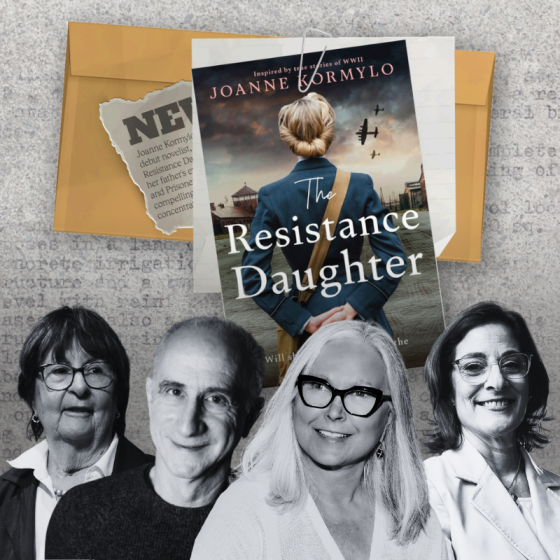
An evening of powerful storytelling in defence of historical truth
At a moment when misinformation distorts the past and public memory is under pressure, Remembrance as Resistance brings Canada’s Second World War stories vividly to life through powerful writers who transform archival fact into unforgettable narrative.
Anchored by the Toronto launch of The Resistance Daughter, Joanne Kormylo’s fact-based historical fiction debut, the novel follows a young Polish resistance fighter who rescues Jewish children, aids a downed Canadian airman, and survives imprisonment in Ravensbrück—a narrative inspired by the experiences of Kormylo’s father, a Canadian bomber pilot shot down over the North Sea and held as a prisoner of war for nearly three years.
Joining Kormylo are bestselling novelist Robert Rotenberg, Murdoch Mysteries creator Maureen Jennings, and journalist-historian Ellin Bessner, whose work recovers the overlooked stories of Jewish Canadians who fought Nazism abroad while facing discrimination at home.
Together, they make a compelling case: when facts are flattened and history is simplified, evidence-based storytelling becomes a form of civic protection.
Joanne Kormylo
Calgary based lawyer and Canadian debut novelist whose historical fiction book, The Resistance Daughter, was acquired by the UK’s legendary Hodder and Stoughton.
Robert Rotenberg
A Criminal Lawyer and bestselling Toronto based novelist best known for his internationally acclaimed Ari Greene detective series.
Maureen Jennings, O.C.
Beloved creator of the Murdoch Mysteries, and Bomb Girls, whose work has shown generations of Canadians that serious history can be explored with wit, warmth, and narrative drive.
Ellin Bessner
Journalist and historian, whose book Double Threat: Canadian Jews, the Military and World War II, uncovers the stories of Jewish Canadians who fought Nazism overseas while facing discrimination at home.
Buy tickets at: Remembrance As Resistance: Why Canada’s WWII Stories Matter Now